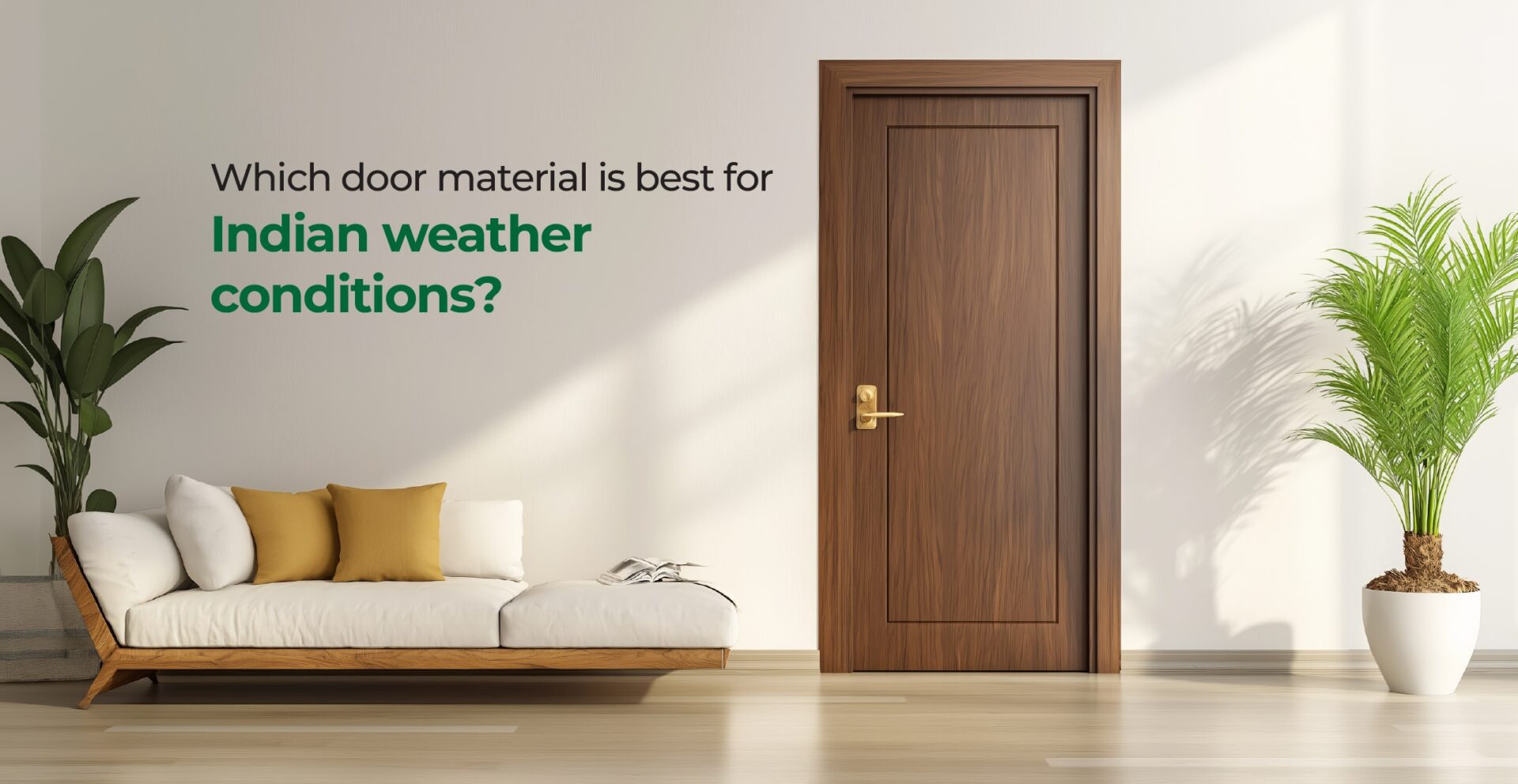
India’s climate is as diverse as its culture. From the scorching summers of Rajasthan to the humid coasts of Kerala, and from the chilly winters of the North to the monsoon-heavy cities across the country, our homes endure a lot. Doors, being the first line of protection for any living space, face these weather extremes every day.
So, choosing the right door material is not just a design decision, but it is a long-term investment in safety, durability, comfort, and peace of mind. The right material will withstand heat, moisture, pests, and daily wear, while still looking good for years. The wrong one can warp, swell, fade, crack or even become structurally weak within a short time.
Here’s a complete guide to understanding which door material performs best across India’s varied weather conditions.
Table of Contents
- Why weather-resistance matters in India?
- Solid wood doors
- Flush doors
- PVC and UPVC doors
- Steel and metal doors
- FRP doors
- Engineered wood doors
- Which door material handles Indian weather best?
- The smart choice for long-lasting homes
Why weather-resistance matters in India?
Before comparing materials, it helps to understand why the Indian climate demands more from doors than many other countries. India experiences:
- Intense sun exposure that can fade colour and dry out wood
- Extreme humidity that causes swelling, warping, and mold
- Heavy rainfall and monsoons that test water resistance
- Cold winters in some regions that cause contraction and cracking
- High termite activity, especially in tropical areas
- Pollution and dust, which speed up weathering
A good door must handle all these challenges while maintaining its structure, finish, and performance.
Solid wood doors
Timeless but weather-sensitive
Solid wood has been used for centuries and remains a favourite for its natural beauty and strength. But is it suitable for India’s tough climate?
Pros:
Solid wood doors bring warmth, luxury, and sturdiness. They can be carved, polished, or customised easily. Many homeowners love their rich appearance.
Challenges in Indian climate:
Wood reacts quickly to moisture and temperature changes.
- It swells during monsoons
- Cracks during harsh summers or winters
- Attracts termites, unless treated
- Needs regular maintenance, including polishing
Solid wood works only when it is high quality, seasoned well, and used in areas with stable climate conditions. For coastal and humid regions, it is less reliable.
Flush doors
Strong, stable and ideal for most Indian homes
Flush doors are becoming increasingly popular in modern Indian homes due to their practical performance. Made using a solid or hollow core and covered with plywood or veneer, they are engineered for durability.
Why they suit Indian weather:
- They have excellent dimensional stability, meaning they do not warp or expand easily
- They perform well in humid and monsoon-prone areas
- Termite and borer-resistant variants (like those offered by premium brands) provide long-term protection
- They can be coated, veneered, or laminated to suit any style
- They require minimum maintenance compared to solid wood
For most Indian climates—coastal regions, dry regions, and even colder zones—flush doors provide the best balance of beauty and endurance.
PVC and UPVC doors
Good for wet areas, not for the whole home
PVC and UPVC doors are often used in bathrooms or utility areas where moisture levels are high.
Advantages:
- Completely water-proof
- Low maintenance
- Affordable
Limitations:
PVC doors lack the rigidity needed for main and room doors. They can fade, bend, or crack when exposed to harsh sun. They also don’t offer the premium aesthetic many homeowners desire. UPVC is stronger, but still better suited for windows and utility zones, not living rooms or bedrooms.
For internal wet areas, PVC/UPVC is fine. But for aesthetics, security, or weather resistance throughout the home, they fall short.
Steel and metal doors
Durable but not always home-friendly
Metal doors are extremely strong and weather-resistant.
Pros:
- Excellent protection from intruders
- Fire-resistant
- Highly durable in harsh weather
Cons:
- They heat up in summer
- Prone to rust if not coated well
- Limited in terms of home décor
- Not suitable for interior spaces
Metal doors are ideal for industrial environments, but not the preferred choice for residential aesthetics.
FRP doors
Resistant but limited in look
Fiberglass Reinforced Plastic (FRP) doors are designed to handle moisture, salt air, and heavy rain.
Strengths:
- Water-resistant
- Termite-proof
- Long-lasting
Weaknesses:
- Appearance is limited
- Not as premium-looking as wood or veneer-finished doors
They work well for coastal cities but may not offer the elevated look architects seek for luxury homes.
Engineered wood doors
The modern all-rounder
Engineered wood doors combine aesthetics with high performance. These doors are made using composite cores for strength, and then finished with veneer or laminate.
Why architects love them:
- They resist warping and swelling better than solid wood
- They look premium due to natural veneer finishes
- Available in fire-resistant, moisture-resistant, and termite-resistant variants
- Lightweight yet strong
- Perfect for high-end residential and commercial projects
Engineered doors sit at the sweet spot between beauty and durability, making them ideal for cities like Chennai, Mumbai, Delhi, Kolkata, Bengaluru, and Hyderabad that experience mixed climatic conditions.
Which door material handles Indian weather best?
After evaluating all options, one material consistently stands out: Flush Doors with a superior core and high-quality veneer or laminate finish.
Here’s why:
- They remain stable through heat, humidity, and monsoons
- MR, BWR or BWP grades provide moisture resistance
- Termite-proof variants perform reliably across India
- They offer customisable finishes—natural wood veneers, laminates, textures
- They are budget-friendly compared to solid wood
- They require little maintenance
- They enhance both home security and interior aesthetics
For homeowners and architects seeking reliability paired with refined style, high-quality flush doors outperform most other door materials in India’s demanding climate.
The smart choice for long-lasting homes
Choosing the right door material can feel overwhelming, but when you consider India’s intense climatic variations, the answer becomes clearer. A well-engineered flush door offers the stability, durability, and long-term performance that modern homes need. SharonDoor brings these advantages together with refined aesthetics, ensuring that every flush door is built to withstand humidity, heat, monsoons, and termite exposure with ease. For homeowners and architects seeking doors that stay strong, look elegant, and support comfortable living year after year, a SharonDoor is a dependable choice. As a high-quality flush door, it remains one of the most reliable solutions crafted thoughtfully for the realities of Indian weather.