When it comes to modern furniture and affordable interior construction, particle board is often a go-to material. Known for its versatility and cost-effectiveness, this engineered wood product has become a favourite in residential and commercial settings. Made by compressing wood chips, sawdust, and resin under high pressure, particle board offers a smooth surface ideal for laminates and veneers.
Whether you are planning custom furniture or designing a modular kitchen, understanding the its type can help you choose the right material for your needs.
Table of content
- What is particle board?
- Types of particle board
- Common particle board uses
- Advantages of using particle board
- How to choose the right type of particle board
- Make informed material choices for lasting interiors
What is particle board?
It is an engineered wood product created by binding wood particles—such as chips and sawdust—with synthetic resins. These boards are then pressed into sheets under heat and pressure to form panels of uniform thickness. Unlike solid wood, it is lightweight, cost-effective, and easy to work with. It is widely used in applications where heavy loads are not a concern but affordability and surface finish are priorities.
Thanks to its smooth surface and compatibility with laminates and melamine films, it is commonly used in furniture manufacturing, cabinetry, and interior wall partitions.
Types of particle board
There are several types of particle board, each designed for specific applications. Understanding their differences helps in selecting the right kind for your project.
1. Single-layer particle board
This type of particle board is made from a single, uniform layer of compressed wood particles. The density is consistent throughout, but the surface may not be completely smooth. As a result, it is best suited for structural or non-visible applications where appearance isn’t a top priority.
Common uses: Underlayment, subflooring, packing boxes
2. Three-layer particle board
Three-layer boards feature a core made of larger wood particles, while the outer layers use finer particles for a smoother finish. This type of board provides better surface quality, which makes it suitable for decorative laminates and veneers.
Common uses: Furniture panels, modular kitchen cabinets, wardrobes
3. Graded-density particle board
Also called graduated particle board, this type has varying densities across its thickness. The surface layers are made with fine, dense particles, while the core contains coarser particles. It offers both surface strength and internal stability.
Common uses: Shelves, wall panels, and laminated furniture
4. Melamine-coated particle board
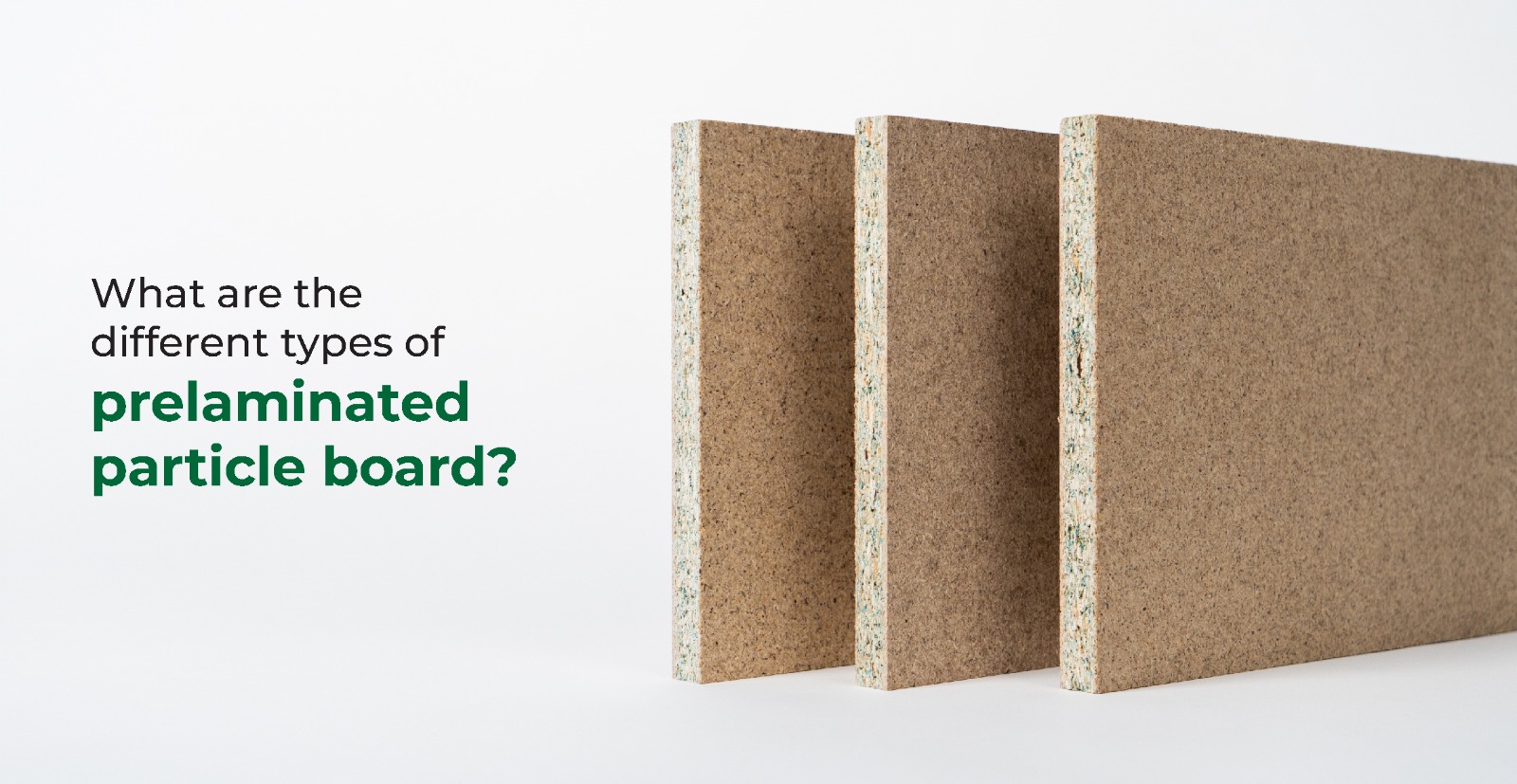
This particle board comes as pre-laminated particle board with a melamine film on one or both sides. Available in a range of colours and finishes, it eliminates the need for extra surface treatment. While it offers moderate moisture resistance, it’s commonly used in ready-to-assemble furniture and interior applications.
Common uses: Office desks, cabinets, modular furniture
5. Veneered particle board
Veneered boards are particle boards covered with a thin layer of natural wood veneer. They provide the look and feel of real wood but at a more affordable price. This makes them a great choice for applications where visual appeal matters but cost needs to be kept in check.
Common uses: Home furniture, decorative partitions, premium wardrobes
6. Cement-bonded particle board
This type combines wood particles with cement as the binding agent. It offers excellent durability, water resistance, and fire resistance compared to regular particle board. It is heavier but more resilient, especially in wet or high-traffic environments.
Common uses: External cladding, roofing, wall linings, and industrial partitions
Common particle board uses
The adaptability of particle board makes it suitable for various applications in homes, offices, and retail spaces. Some of the most common particle board uses include:
- Furniture manufacturing: Perfect for affordable furniture pieces such as tables, desks, and storage solutions
- Cabinetry: Used in kitchens, wardrobes, and bathroom vanities with a laminate or PVC finish
- Interior wall partitions: Lightweight and easy to install, especially for temporary walls
- False ceilings: Particularly the laminated or coated variants
- Packaging and display units: Because of its low cost and easy machinability
- DIY projects: Great for shelving or custom creations at home
While it is not suitable for heavy-duty structural applications or areas with constant moisture exposure, it performs well in dry, controlled environments when installed properly.
Advantages of using particle board
There is a reason particle board has remained popular in modern interiors. Here are a few benefits that make it a practical choice:
- Affordability: Significantly cheaper than solid wood or plywood
- Smooth surface: Ideal for laminates and veneers
- Lightweight: Easier to transport and install
- Eco-friendly: Often made from wood industry waste, reducing environmental impact
- Customisable: Available in various finishes, sizes, and thicknesses
Its only limitations lie in its water sensitivity and lower load-bearing capacity. However, with proper sealing and placement, these can be managed efficiently.
How to choose the right type of particle board
Not all particle boards are created equal. When selecting one for your project, keep the following factors in mind:
- Application area: For kitchens or wardrobes, opt for melamine or veneered variants
- Moisture exposure: Avoid using plain boards in damp areas unless coated or sealed
- Aesthetic needs: Use veneered or laminated boards where appearance matters
- Load requirements: Heavier boards like cement-bonded ones are better for weight-bearing structures
- Budget: Balance functionality with cost depending on the use case
Consulting a trusted brand or dealer can help you get the best match for your specific needs.
Make informed material choices for lasting interiors
Particle board has carved a niche for itself in the world of engineered wood due to its versatility, affordability, and ease of use. Whether you need panels for a new wardrobe or are building modular office furniture, choosing the right types of particle board can impact both performance and aesthetics.
By understanding the specific use, you can plan your interiors more efficiently, without compromising on design or functionality. And when quality and reliability are a priority, choosing from a reputed brand becomes just as important. At SharonPly, we offer a range of high-performance particle board solutions tailored for every need—from basic utility panels to decorative finishes. Crafted for quality and engineered to last, our products ensure that your interiors look great and stay strong.