In the world of interior design and modern furniture making, the debate between pre-laminated vs laminated boards is more relevant than ever. While both materials may appear similar at first glance, their manufacturing processes, performance, and use cases differ significantly. Understanding these differences can help you make better choices, especially when it comes to durability, aesthetics, and cost.
Whether you are a furniture maker, a contractor, or a homeowner planning your next renovation project, choosing the right board can influence both the look and longevity of your interiors. Let’s break down the key aspects of pre-laminated vs laminated boards in a straightforward, comparative way.
Table of contents
- Understanding the basics
- Key differences at a glance
- Performance & practical considerations
- Which one should you choose?
- A quick word on sustainability
- Wrapping it up with confidence
Understanding the basics
Before diving into pros and cons, it is important to understand what each term means.
What are pre-laminated boards?
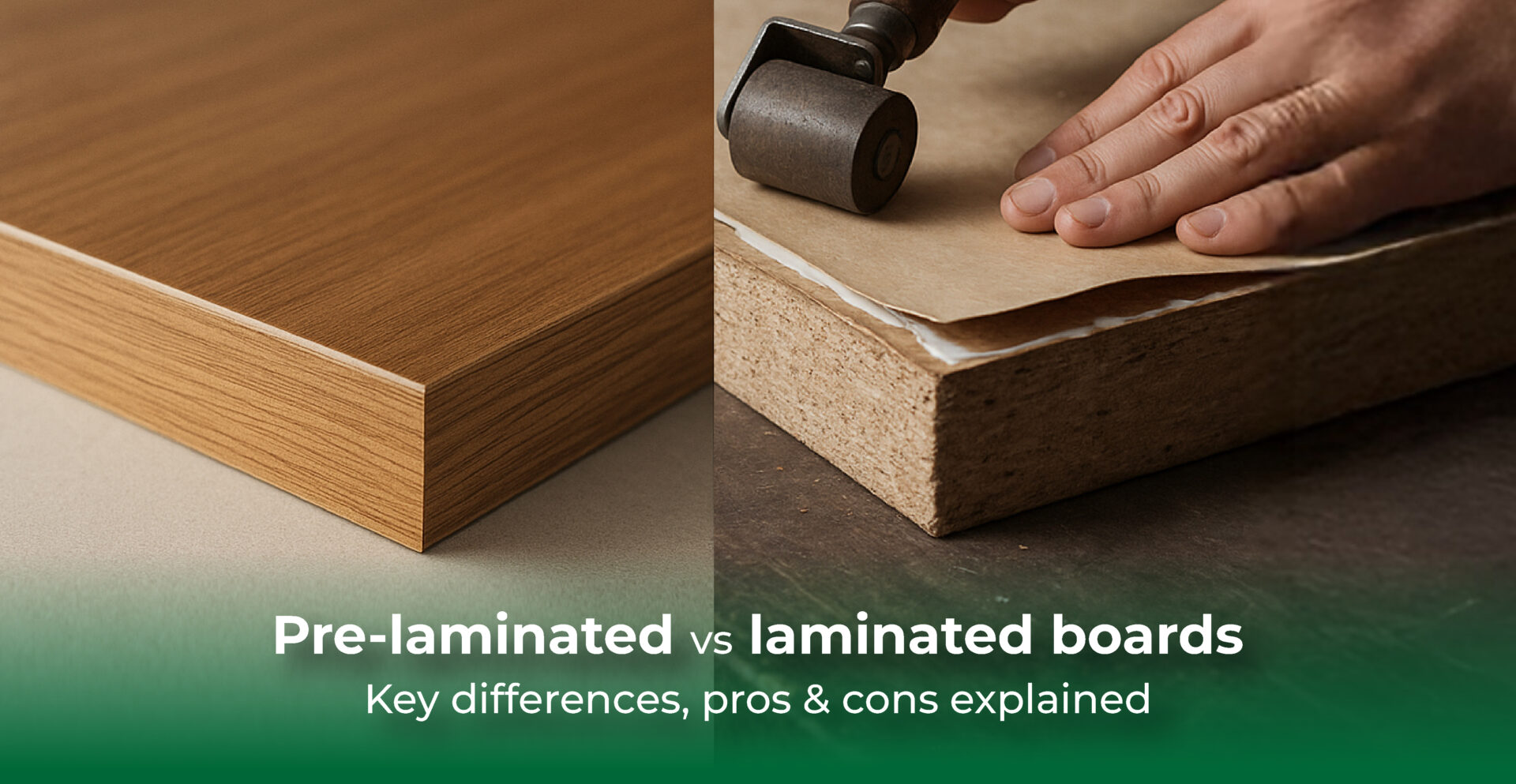
Pre-laminated boards are factory-finished panels where a decorative laminate layer is bonded to both sides of the particleboard or MDF before it reaches the user. This ensures uniformity in appearance and a faster installation process. These boards are available in a variety of colours, textures, and finishes.
What are laminated boards?
Laminated boards, on the other hand, are base boards (like plywood or MDF) that are manually laminated at a later stage. The laminate sheet is glued using industrial adhesives post-manufacturing, which allows for more customisation in finish and pattern selection.
Key differences at a glance
| Feature | Pre-Laminated Boards | Laminated Boards |
| Manufacturing | Laminated at the factory | Laminated manually post-production |
| Installation | Faster and cleaner | Requires skilled labour |
| Design flexibility | Limited to available finishes | Highly customisable |
| Edge Finishing | Uniform and clean | May require edge banding |
| Durability | Moderate | Generally, more durable depending on quality |
| Cost | More affordable | Can be slightly expensive |
Performance & practical considerations
Aesthetics and finish
Pre-laminated boards offer a sleek, uniform finish straight out of the factory, making them ideal for why pre-laminated particle boards are perfect for modern interiors, where speed and standardisation matter, such as commercial interiors or modular furniture.
Laminated boards, on the other hand, offer greater freedom in terms of design. You can mix and match textures, go for high-gloss or matte laminates, or even mimic materials like stone or wood grain.
Customisation
When it comes to custom-built furniture or luxury projects, laminated boards are preferred for their ability to adapt to specific design requirements. With pre-laminated boards, what you see is what you get—quick and standardised, but limited in personalisation.
Time and installation
One of the biggest advantages of pre-laminated boards is the time they save during installation. There is no need for additional lamination work on site, which makes the entire process quicker and cleaner. For laminated boards, you need skilled labour to manually apply the laminates—this can add time and cost, but may be necessary for custom designs.
Durability & usage
Pre-laminated boards are suitable for interiors with light to moderate wear and tear. They are perfect for wardrobes, bookshelves, or office partitions. For guidance on keeping these boards in top condition over time, check out easy tips to maintain your pre-laminated particle boards.
Laminated boards tend to have stronger bonding and can withstand more wear, making them better for surfaces that face regular friction or heavy use, like kitchen cabinets, countertops, and workstations.
Cost factor
If you are working on a budget and need a clean, consistent look, pre-laminated boards make economic sense. They reduce labour costs and material wastage.
Laminated boards, while slightly costlier due to added labour and customisation, justify the price with superior design flexibility and potentially better durability.
Which one should you choose?
It all comes down to purpose. For commercial spaces, rental properties, or modular furniture systems where speed, uniformity, and cost matter, pre-laminated boards are perfect. They offer ease of use, less hassle, and still look good.
But if you are building a home with a strong personal style, or furnishing high-use areas like kitchens and study tables, laminated boards might be a better long-term investment. The flexibility and stronger bonding of laminates ensure they hold up better in demanding environments.
A quick word on sustainability
Pre-laminated boards typically use less glue during installation and result in less onsite wastage. However, laminated boards—especially when paired with eco-friendly adhesives and responsibly sourced laminates—can also be a sustainable option. The key is choosing a trusted brand that adheres to environmental standards.
Wrapping it up with confidence
Choosing between Pre-Laminated vs Laminated Boards is not just about price—it is about knowing your needs. Both options have their own strengths. If you are in a time crunch and want something clean and functional, go for pre-laminated boards. If you are chasing unique designs and a superior finish, laminated boards offer more value. At the end of the day, it is about balancing design, performance, and budget. And if you are looking for engineered panels that tick all these boxes with top-tier quality and reliability, SharonPly is a name that stands tall in the Indian plywood and panel board industry. With a range that includes both pre-laminated and laminated options, SharonPly is built for projects that need precision, performance, and personality.